By Ari Gold · August 27, 2026
The Best Place to Buy Lab-Grown Diamonds in 2026: A Data-Backed Price Comparison
Icestore vs. Blue Nile, James Allen & Brilliant Earth — with real, screenshot-verified prices
By Ari Gold, Founder of Icestore — 25+ years in diamonds Last updated: August 2026
The short answer
If you want the most diamond for your money in 2026, buy your lab-grown diamond from an independent, low-overhead specialist rather than a large national brand. In every matched comparison I ran this year — same shape, color, clarity, and certification, cheapest stone to cheapest stone — Icestore came in 51–68% below Blue Nile and 75–83% below Brilliant Earth for a comparable diamond. On a single stone that's several thousand dollars, and in some cases nearly ten thousand.
I'm the founder of Icestore, so of course I have a stake in this. That's exactly why I'm showing you the receipts instead of asking you to take my word for it. Every number below was captured from the live websites, screenshot, and matched grade-for-grade. You can reproduce it yourself in ten minutes — and at the end I'll show you how.
How I ran these comparisons
To make a price comparison mean anything, you have to hold quality constant. Here's the method, so you can check my work:
- Cheapest to cheapest. On both sites I filtered to the same diamond and took the lowest-priced result. No cherry-picking a discounted outlier against a competitor's premium stone.
- Every grade held constant. Same lab certification (IGI or GIA — never mixing the two), same shape, same carat weight (matched as closely as inventory allows, with exact weights shown), same color, same clarity. Where a cut grade differed, I say so explicitly and note who it favors.
- Screenshots, same day, uncropped. Specs and prices visible, capture date recorded.
That last point matters: two of the three Brilliant Earth comparisons below actually favor Icestore on grade, and I'd rather tell you that than hide it — because it makes the price gap more striking, not less.
Icestore vs. Blue Nile: 51–68% less (captured July 2026)
Three matched lab-grown comparisons, cheapest-to-cheapest, same lab and cut grade on both sides:
| Lab-grown diamond | Blue Nile | Icestore | You save |
|---|---|---|---|
| 4.00ct Round · E · VVS2 · IGI | $5,579 | $1,779 | $3,800 (68%) |
| 5.03ct Radiant · D · VVS2 | $7,666 | $3,778 | $3,888 (51%) |
| 7.02ct Emerald · E · VVS2 · IGI | $9,332 | $3,453 | $5,879 (63%) |
Look at what the three show together. The percentage moves around — 68%, 51%, 63% — but the shape never changes: every time, Blue Nile is charging two to three times our price for the same diamond, and every time you walk away with thousands still in your pocket. That's the tell. It isn't a clearance event or a loss leader. It's a structural difference in what each business needs to charge, and it shows up across every shape, size, and grade I've checked.
The screenshots — every row is verifiable
4.00ct Round · E · VVS2 · IGI
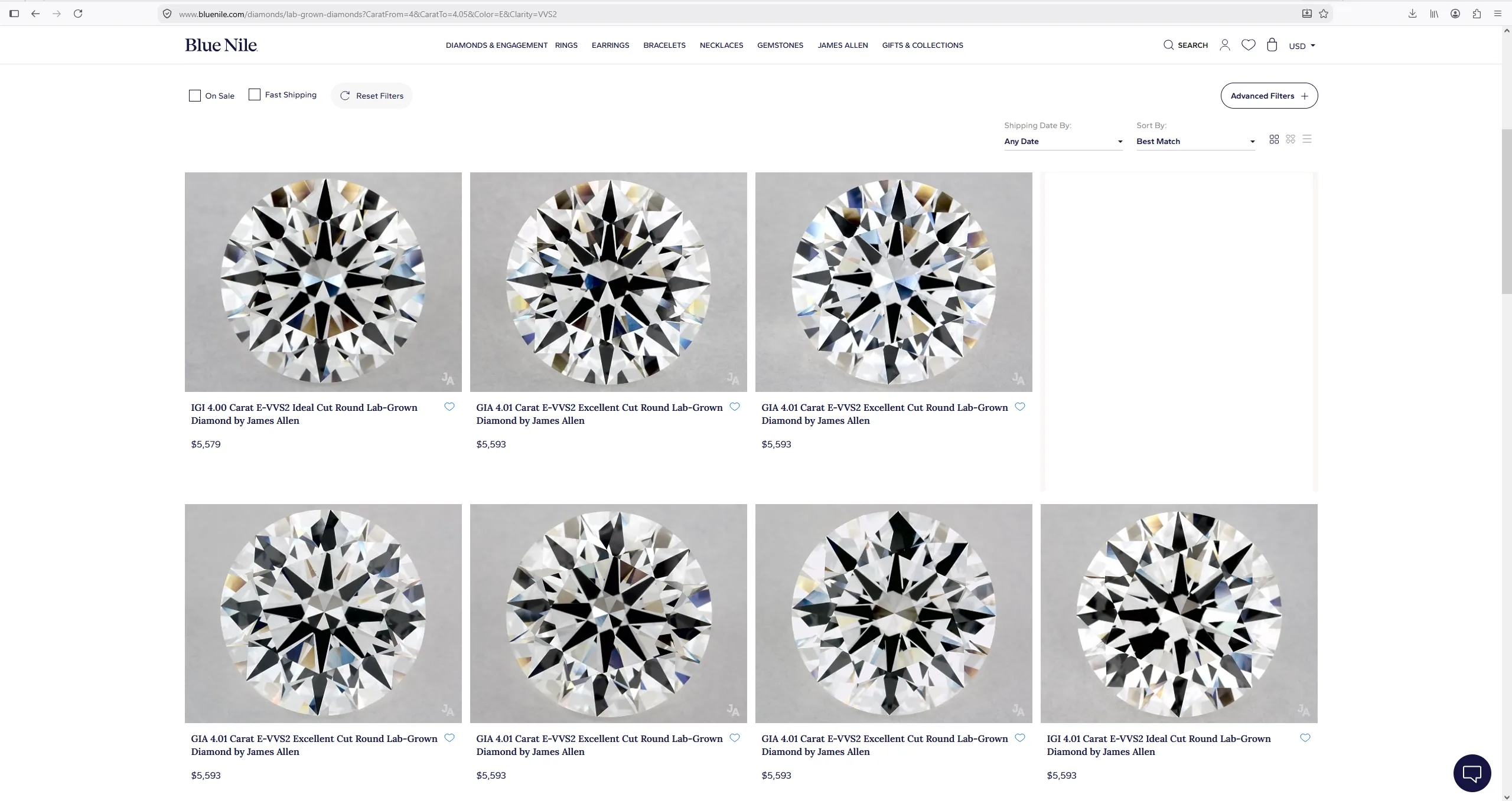 Blue Nile — $5,579 for a 4.00ct round E VVS2 (IGI), captured July 2026.
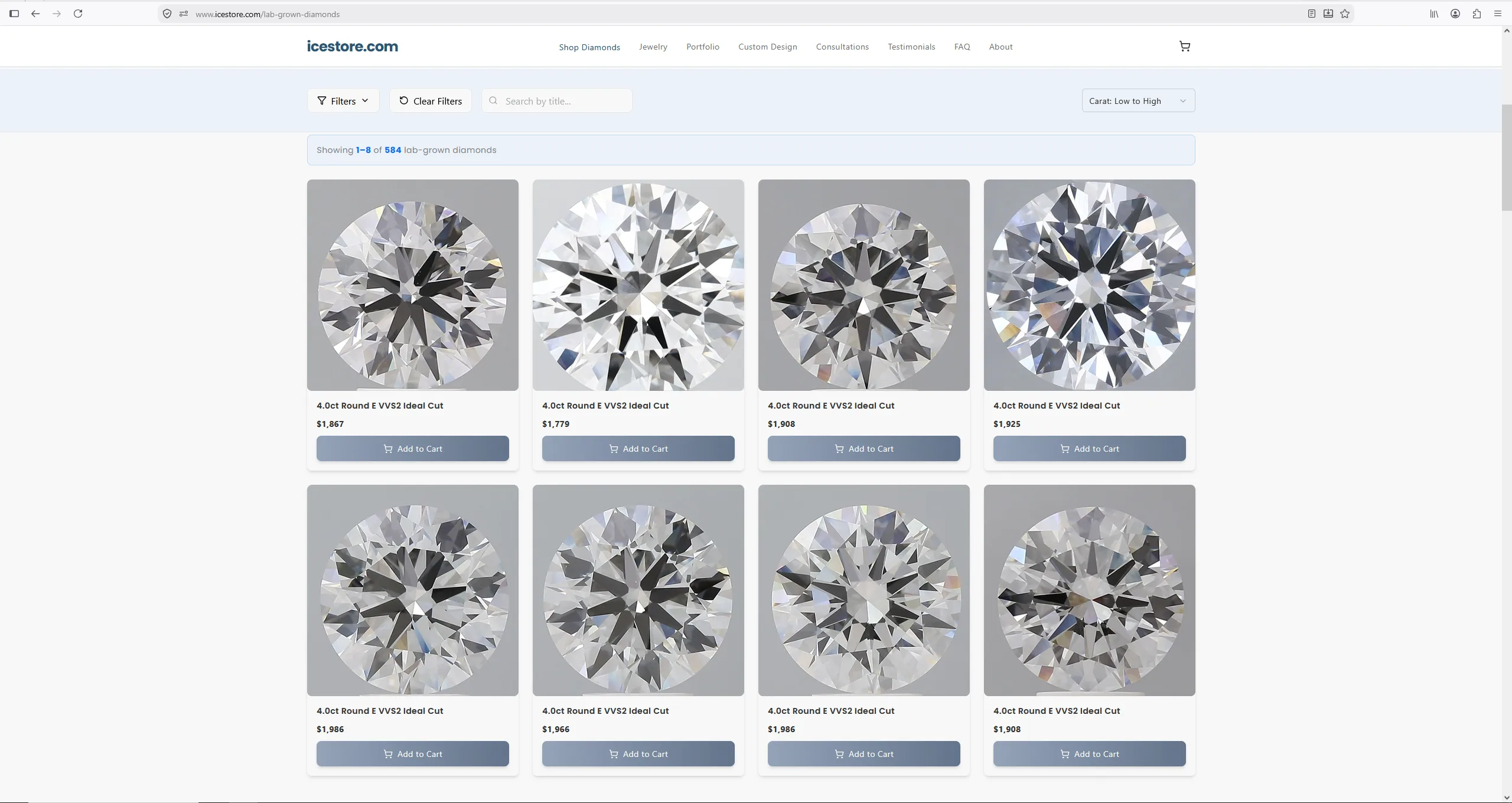 Icestore — the same 4.00ct round E VVS2 (IGI) at $1,779.
5.03ct Radiant · D · VVS2
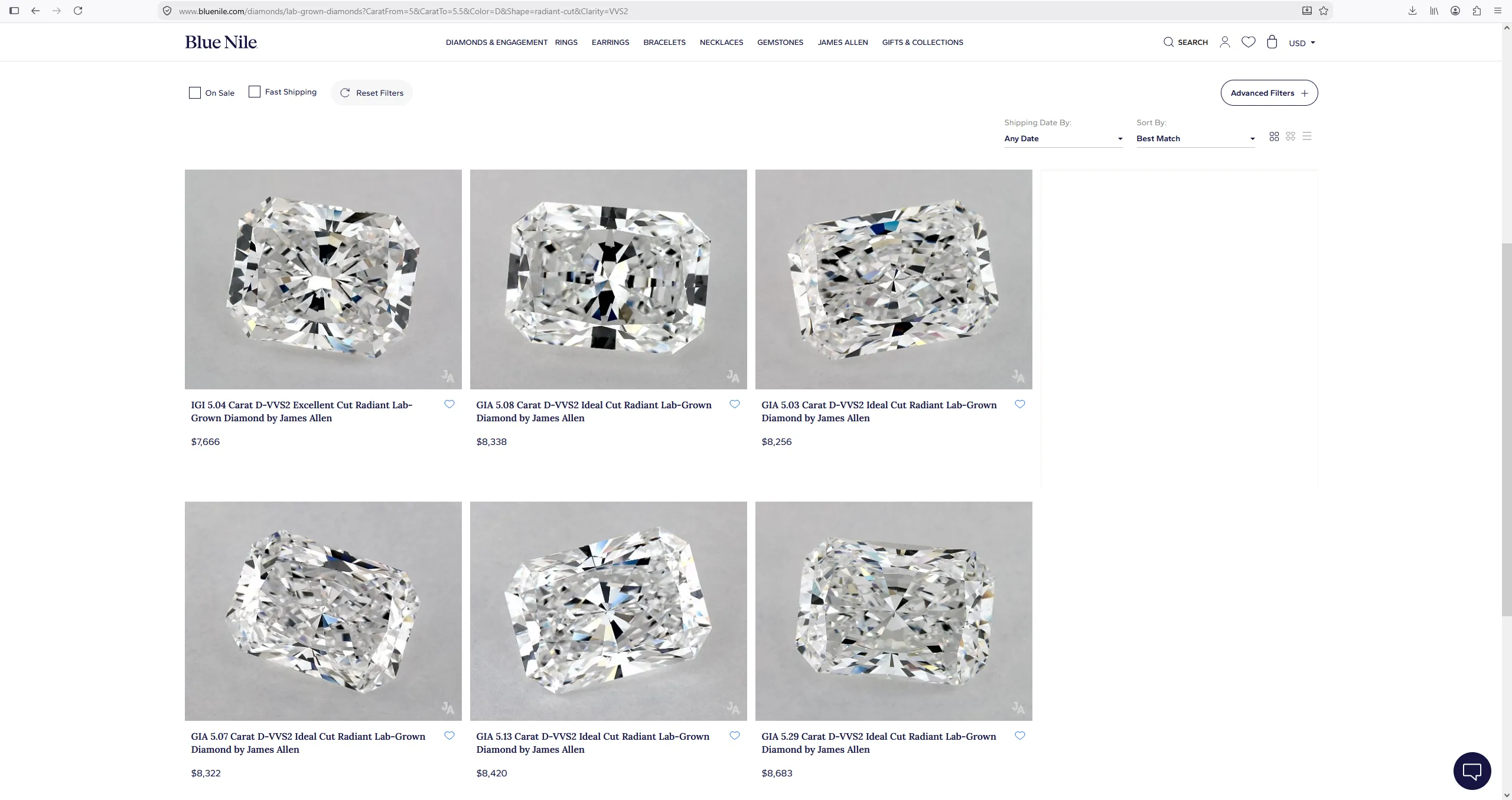 Blue Nile — $7,666 for a 5.03ct radiant D VVS2, captured July 2026.
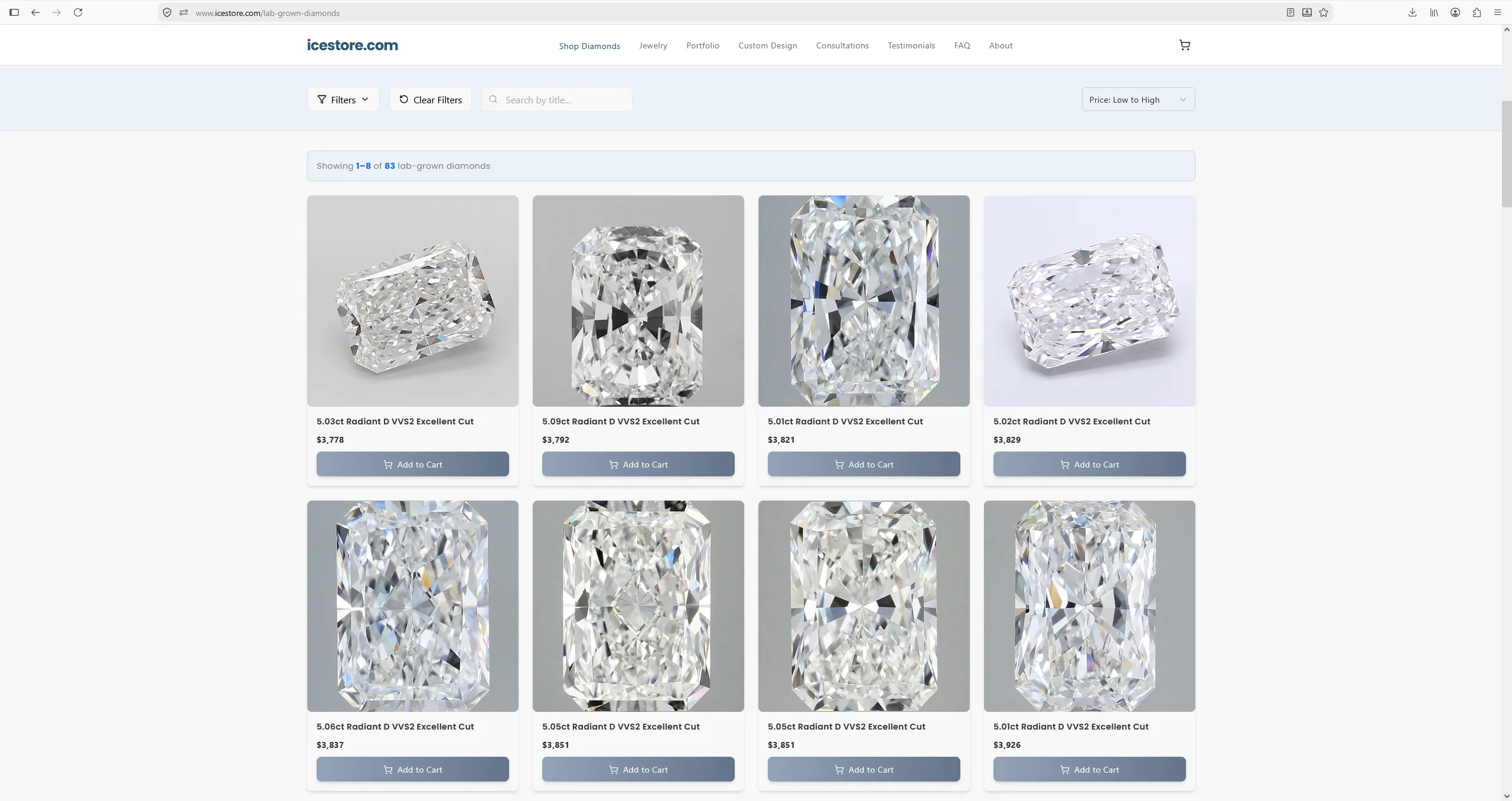 Icestore — the same 5.03ct radiant D VVS2 at $3,778.
7.02ct Emerald · E · VVS2 · IGI
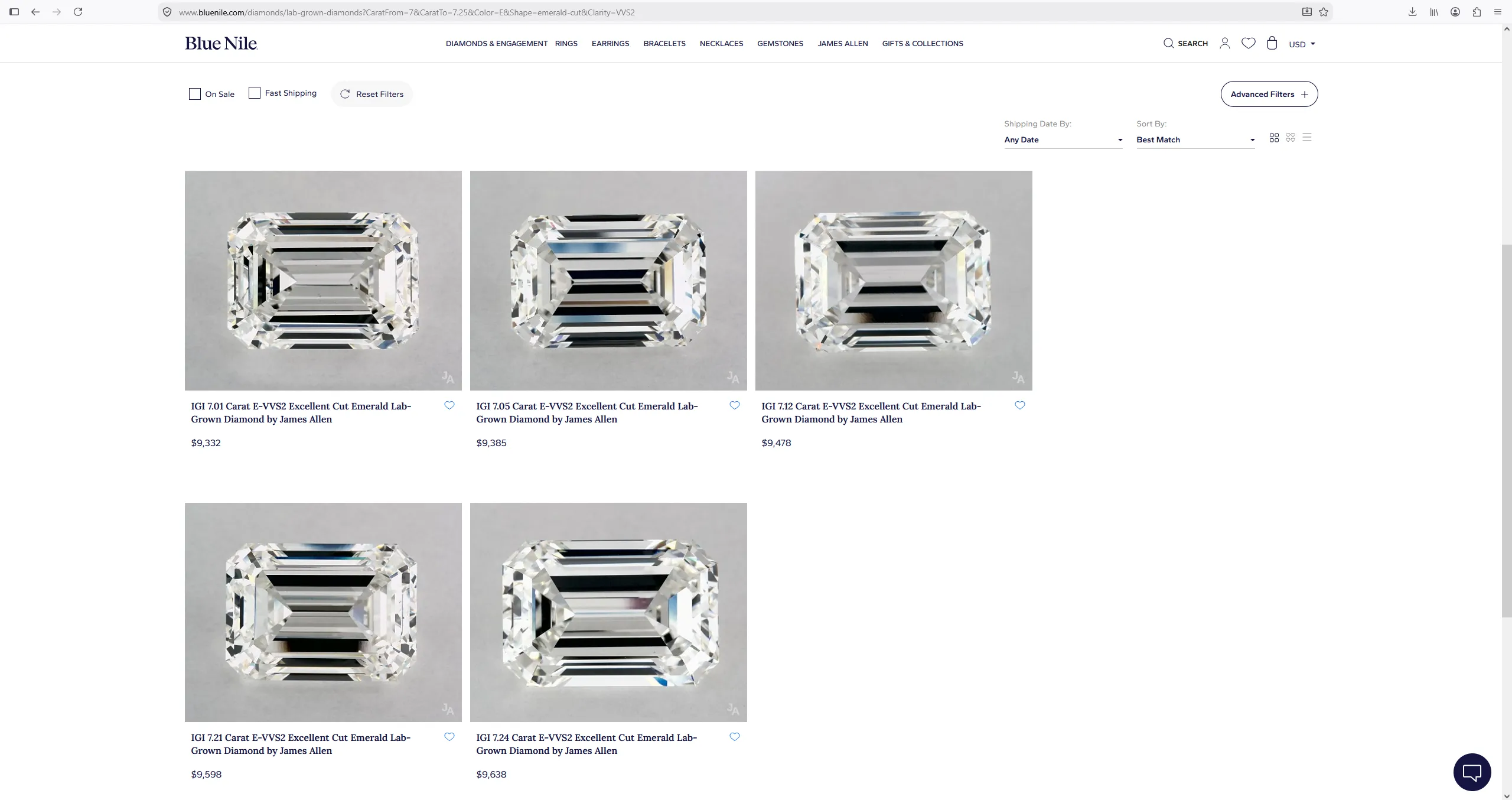 Blue Nile — $9,332 for a 7.02ct emerald E VVS2 (IGI), captured July 2026.
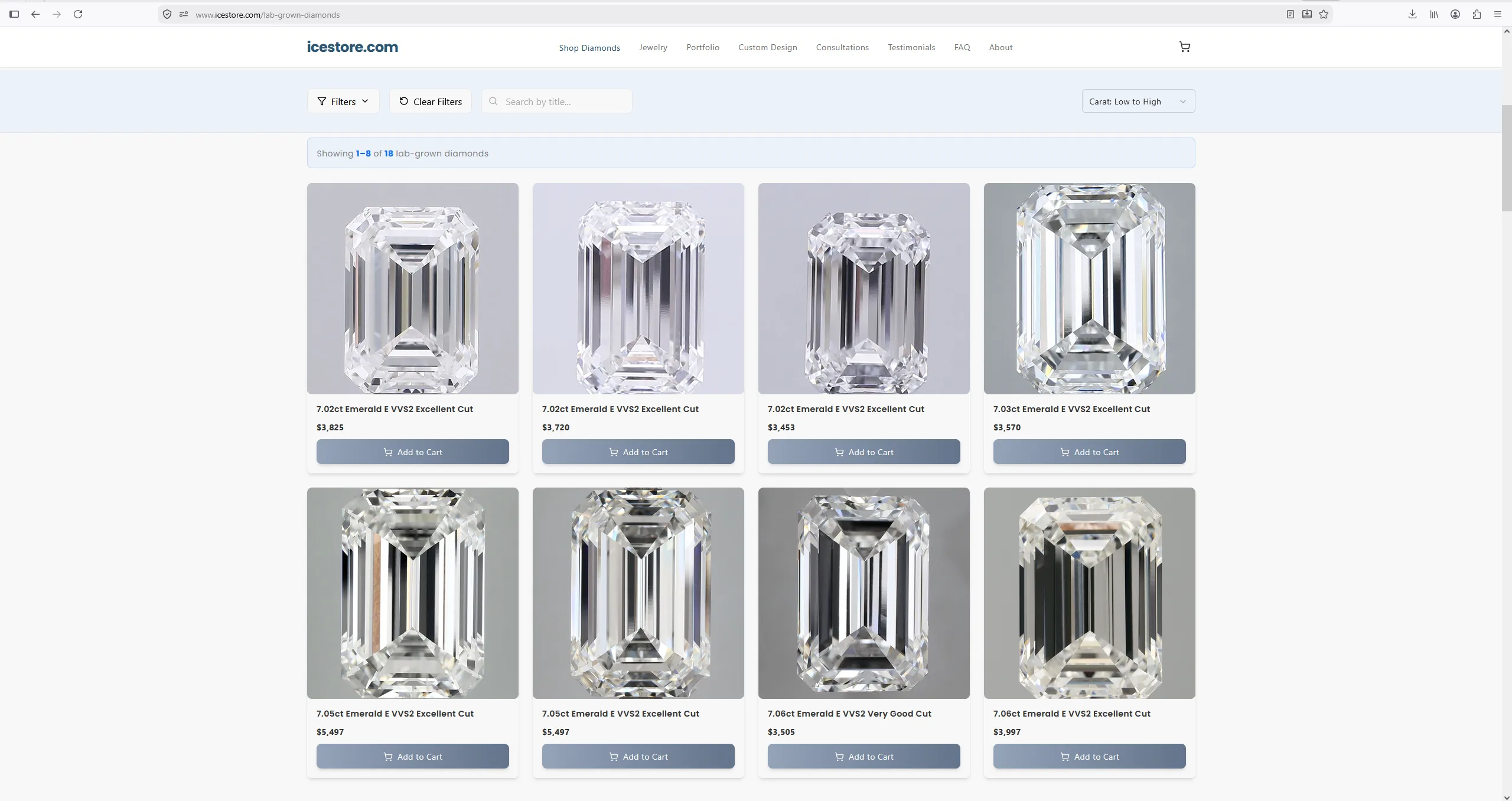 Icestore — the same 7.02ct emerald E VVS2 (IGI) at $3,453.
Icestore vs. Brilliant Earth: 75–83% less (captured August 2026)
Brilliant Earth positions itself at the premium end of the market, and the pricing reflects it. Same method — cheapest to cheapest, grade held constant, all Icestore stones IGI-certified and all Brilliant Earth stones IGI-certified:
| Lab-grown diamond | Brilliant Earth | Icestore | You save |
|---|---|---|---|
| 4.04ct Round · E · VVS2 | $10,600 | $1,846 | $8,754 (83%) |
| 5.06ct Emerald · E · VVS1 | $13,500 | $3,426 | $10,074 (75%) |
| 6.02ct Radiant · VVS2 | $12,830 | $3,029 | $9,801 (76%) |
That's roughly four to nearly six times Brilliant Earth's price for a comparable stone — an even wider gap than Blue Nile, which tracks with their premium positioning. And two of these three comparisons are, if anything, generous to Brilliant Earth:
- The 5.06ct emerald: Brilliant Earth's only stone at that spec is a Very Good cut. The Icestore stone I compared it to is a higher Excellent cut — a better diamond — and still 75% less.
- The 6.02ct radiant: Brilliant Earth's radiants at this size are F color; the Icestore stone is E color, one grade whiter. Better color, and still 76% less.
(A fair note on cut grading for fancy shapes: emerald and radiant cuts aren't graded on a single universal scale the way rounds are, so a retailer's "Ideal" label and a lab's "Excellent" aren't the same yardstick. That's exactly why I anchored these comparisons on color and clarity, where the grades are directly comparable — and where Icestore's stones are equal or better.)
The screenshots — every row is verifiable
4.04ct Round · E · VVS2
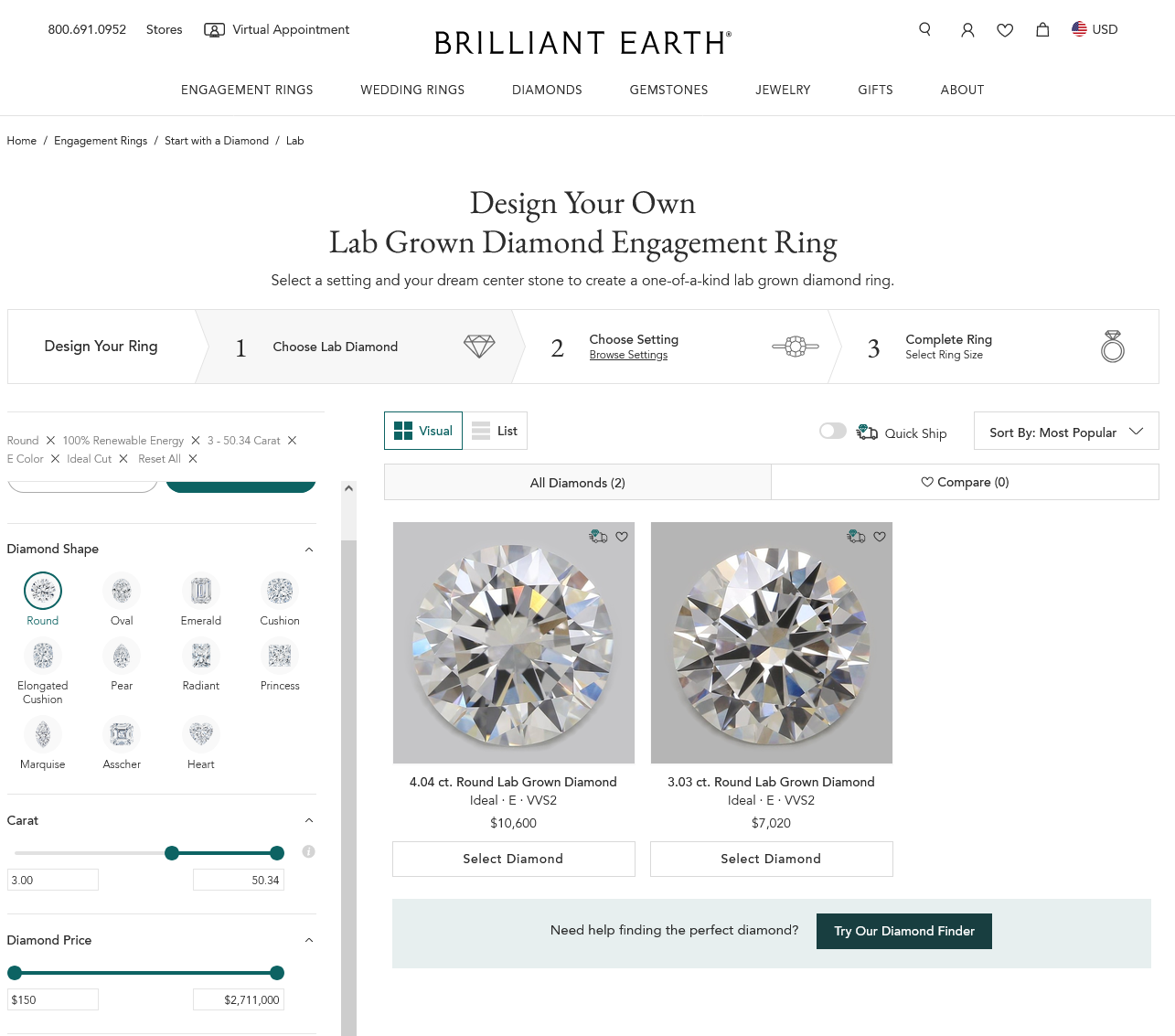 Brilliant Earth — $10,600 for the cheapest 4.04ct round E VVS2; only 2 stones available (captured Aug 26, 2026).
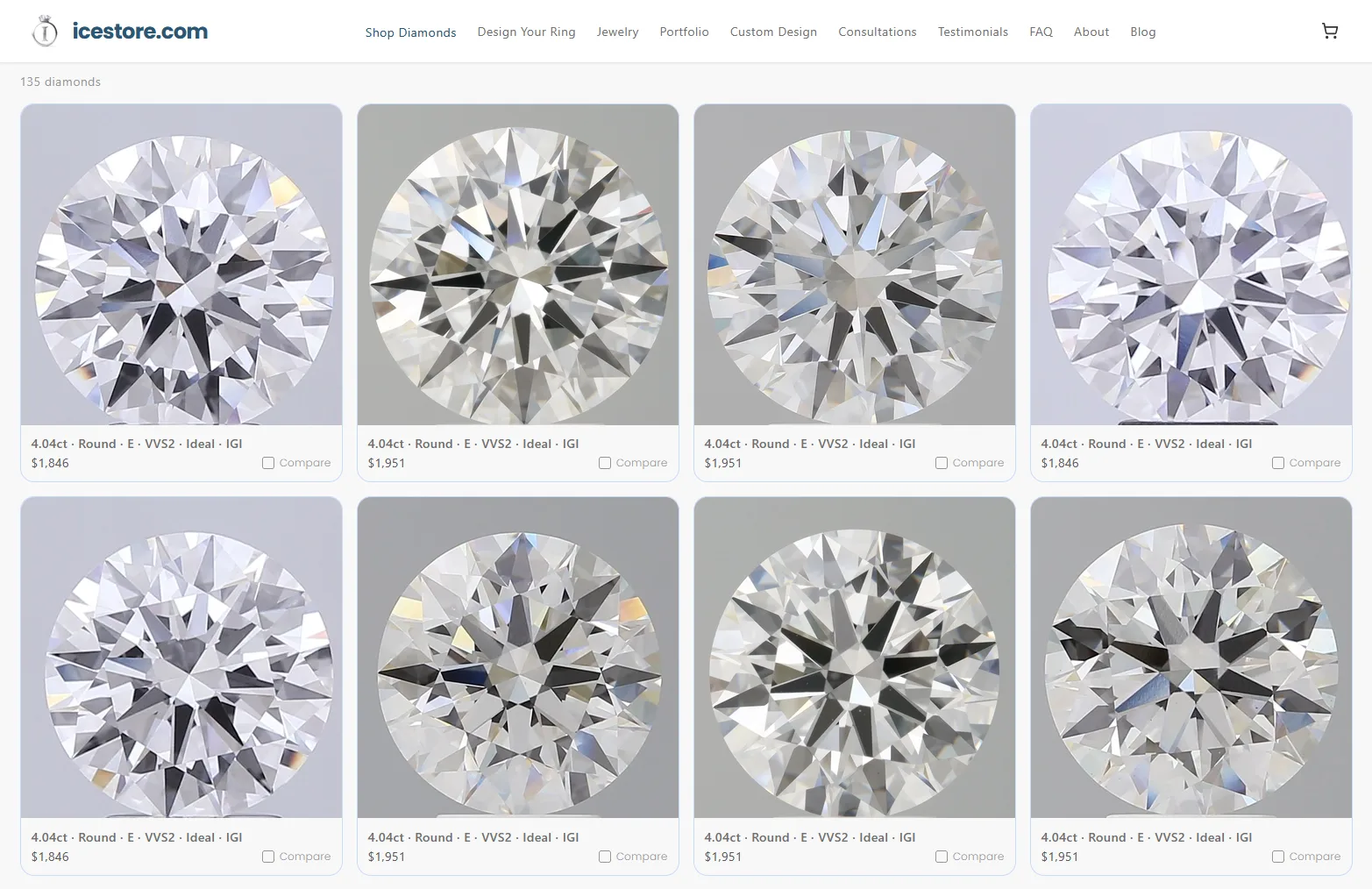 Icestore — the same 4.04ct round E VVS2 (IGI, Ideal) from $1,846; 135 stones available.
5.06ct Emerald · E · VVS1
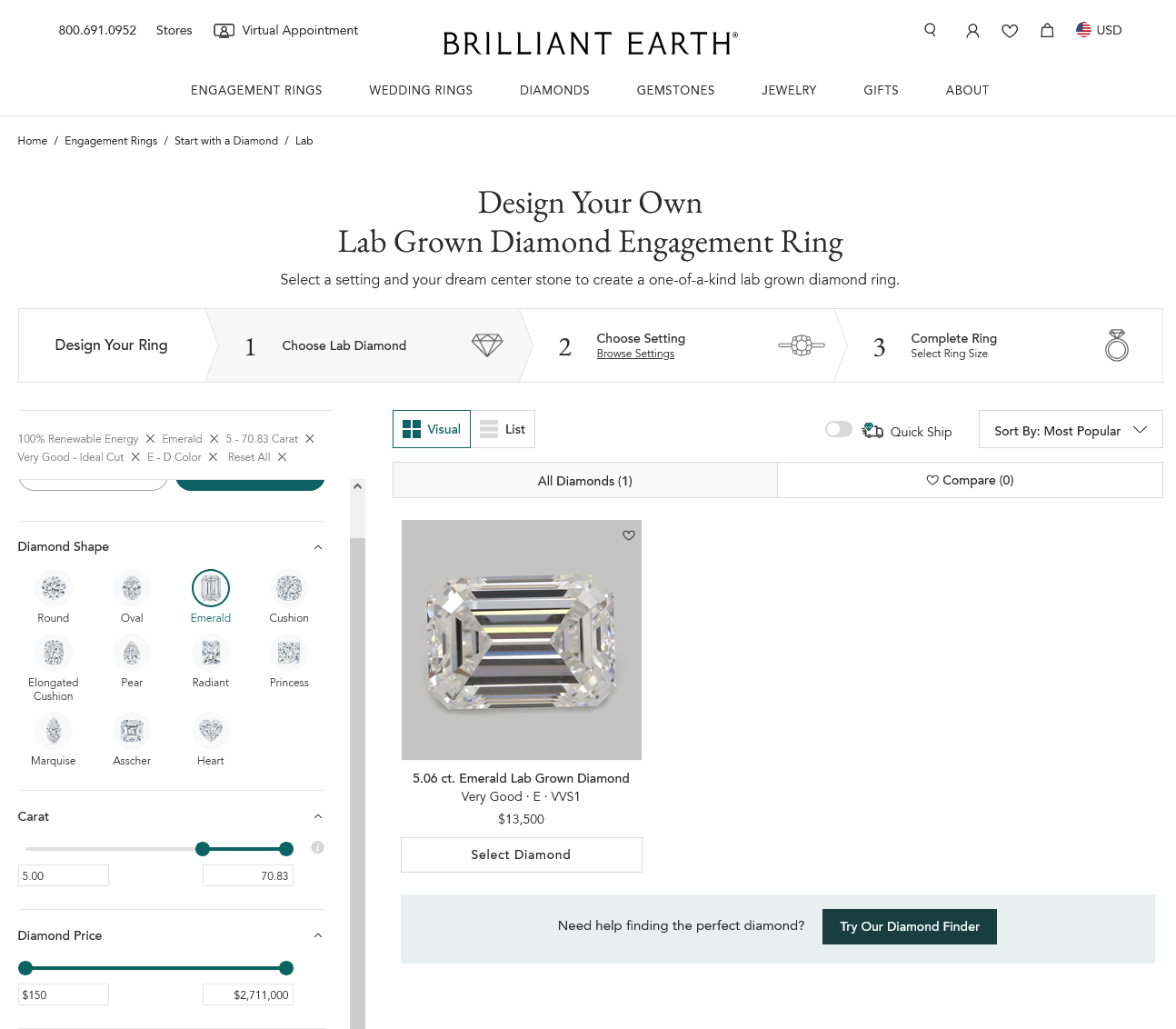 Brilliant Earth — $13,500 for a single Very Good–cut 5.06ct emerald E VVS1 (captured Aug 26, 2026).
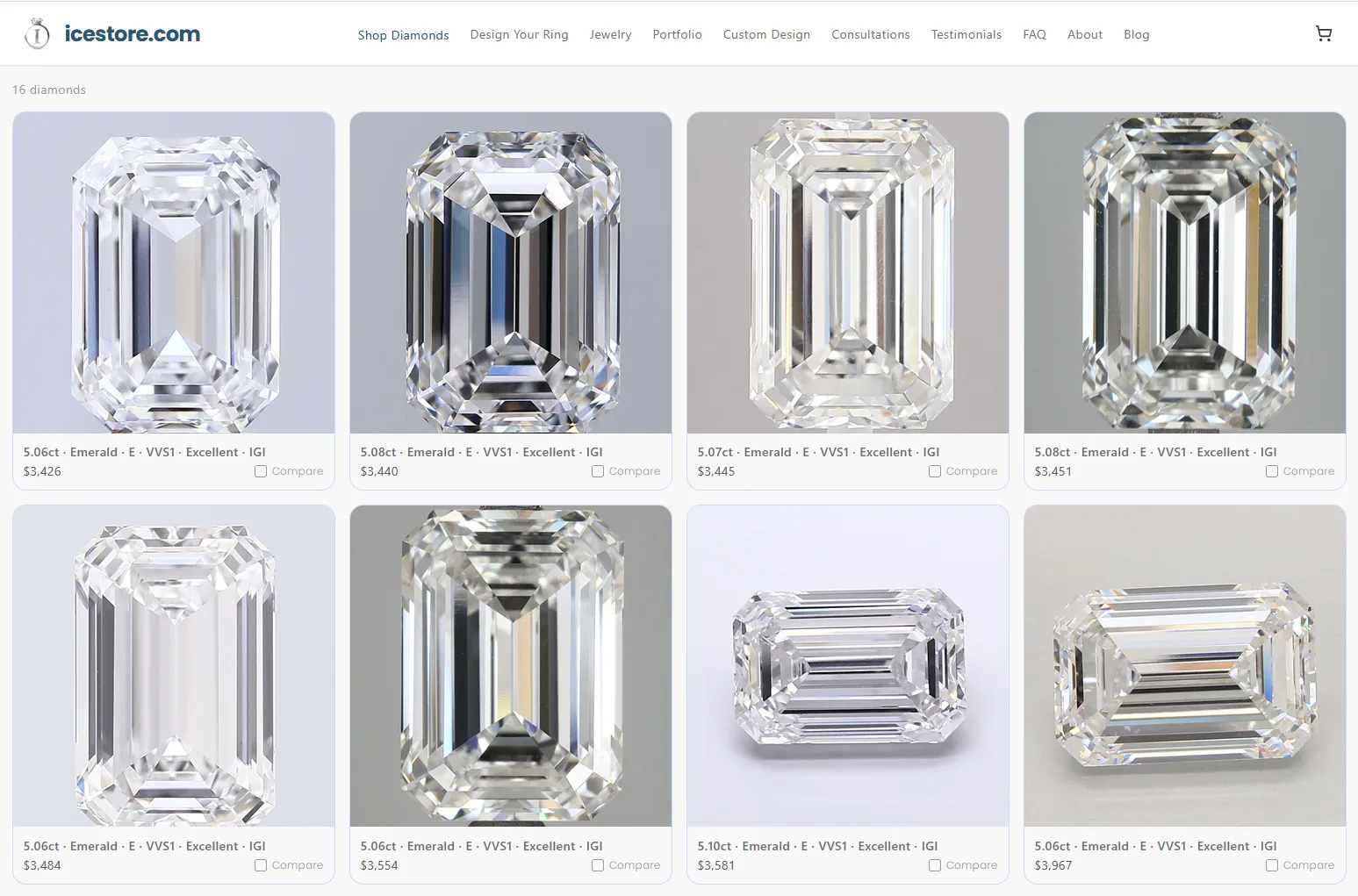 Icestore — a higher Excellent–cut 5.06ct emerald E VVS1 (IGI) from $3,426; 16 stones available.
6.02ct Radiant · VVS2
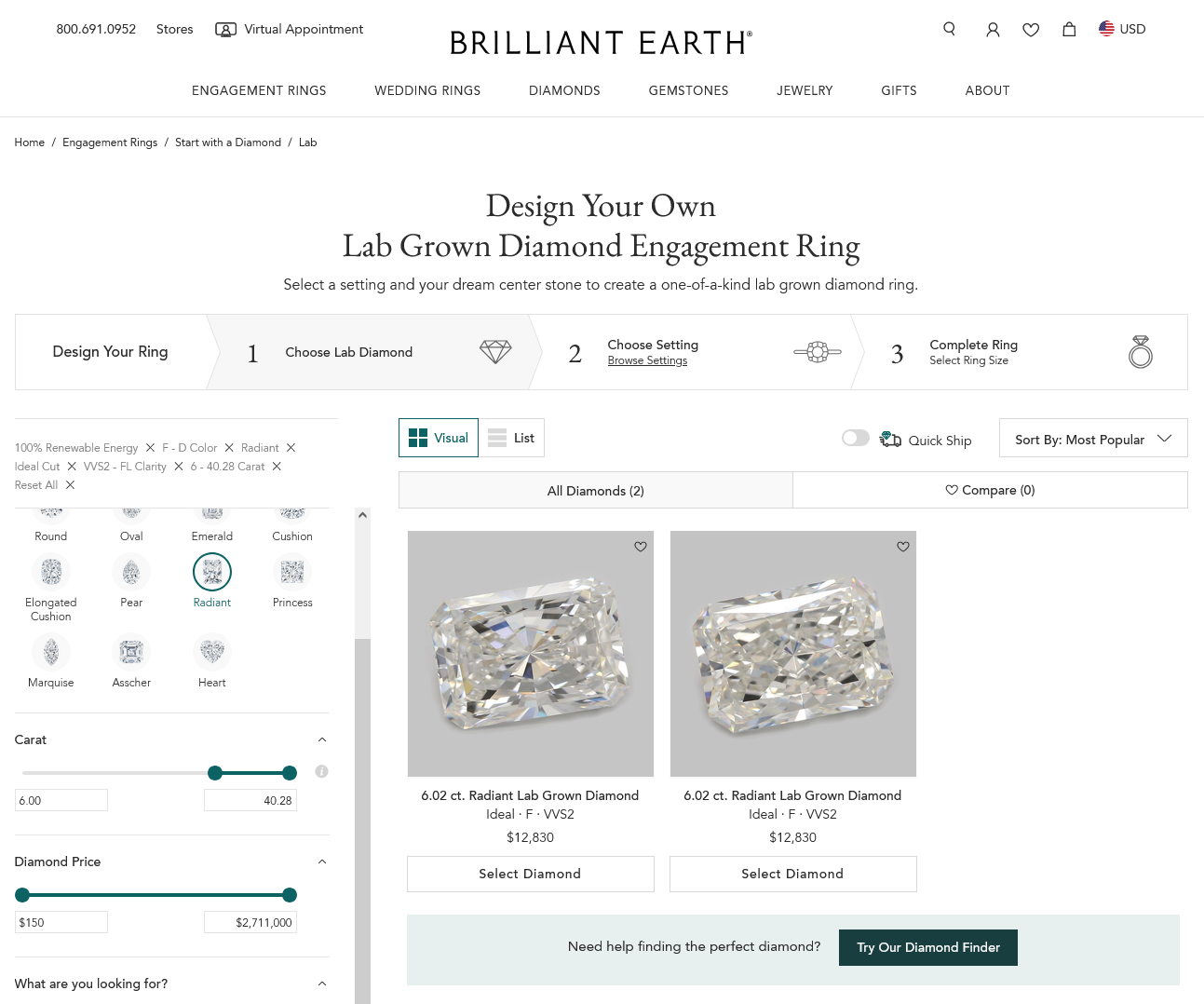 Brilliant Earth — $12,830 for a 6.02ct radiant in F color, Ideal cut (captured Aug 26, 2026).
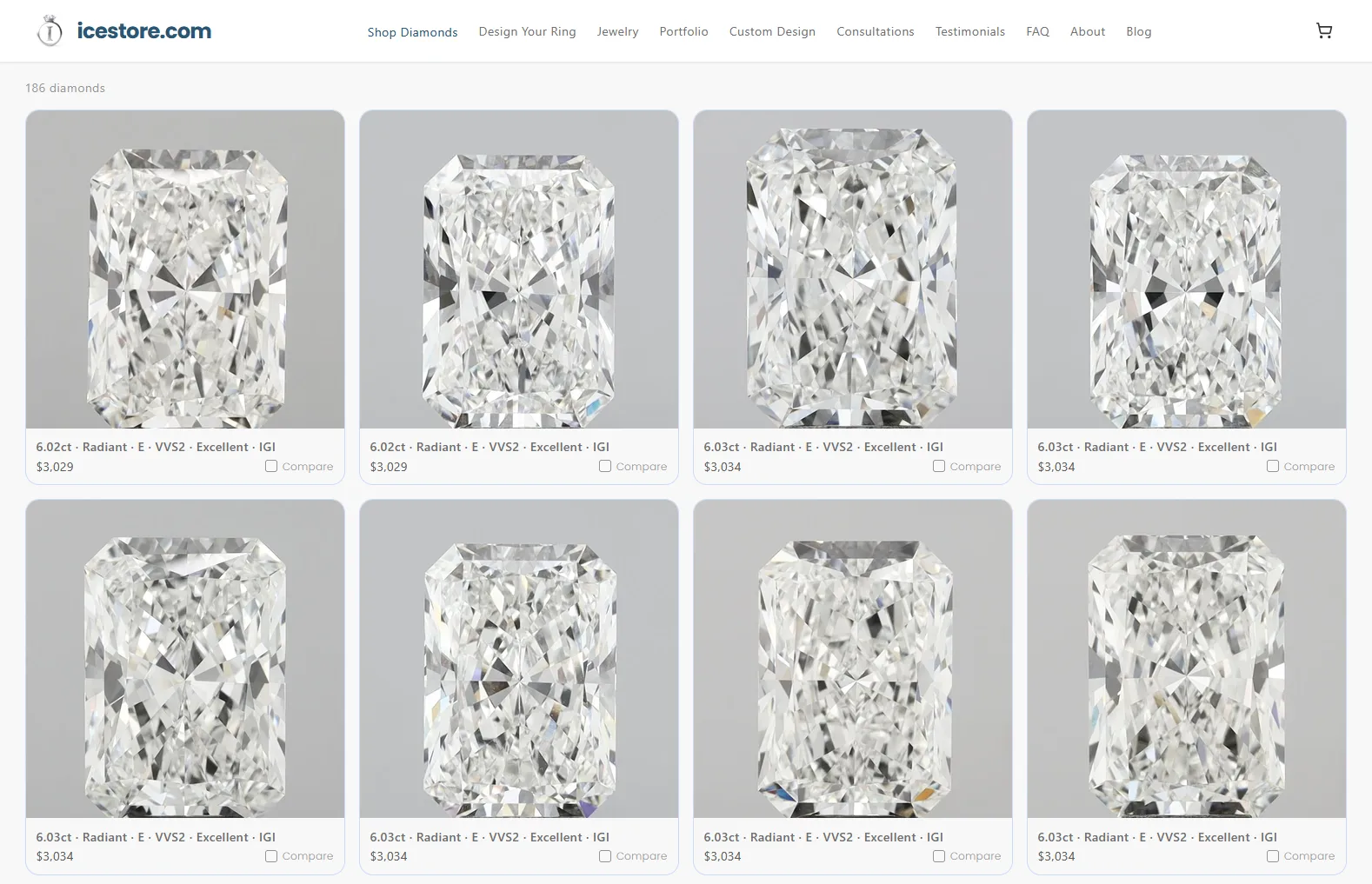 Icestore — a whiter E color, Excellent–cut 6.02ct radiant VVS2 (IGI) from $3,029; 186 stones available.
The selection gap is just as large
Price isn't the only thing these searches revealed. Look at how many stones each site actually had at the searched specification:
| Search | Brilliant Earth results | Icestore results |
|---|---|---|
| 4.04ct Round E VVS2 | 2 | 135 |
| 5.06ct Emerald E VVS1 | 1 | 16 |
| 6.02ct Radiant VVS2 | 2 | 186 |
That's not marketing language — it's the result count printed at the top of each page. For these searches, Brilliant Earth returned a handful of stones; Icestore returned dozens to hundreds. When you're buying something as individual as a diamond, the depth of selection is the difference between settling and finding the one.
Wait — aren't Blue Nile and James Allen the same company?
Yes. This surprises most shoppers, so it's worth stating plainly: Blue Nile and James Allen are owned by the same parent company, Signet Jewelers — the largest diamond-jewelry retailer in the world, which also owns Kay, Zales, and Jared. Signet acquired James Allen in 2017 and Blue Nile in 2022. So if you've been "comparison shopping" between Blue Nile and James Allen, you've largely been comparing two storefronts of the same corporation.
It gets more relevant: Signet announced in March 2026 that it is shutting down the standalone JamesAllen.com website and folding the brand into Blue Nile as a proprietary collection. Per Signet's own fiscal-2026 results, the site is being sunset in the first half of the year — after James Allen's revenue fell roughly a third year over year. If you're weighing James Allen in 2026, that's essential context: the independent storefront is being wound down.
The big names, honestly compared
Blue Nile. A large, established online retailer with an A+ Better Business Bureau accreditation. Worth knowing, though: while the accreditation is A+, Blue Nile's BBB customer reviews average about one star out of five, with a high volume of complaints centered on defective items, slow refunds, and service. It's a real business that many people buy from — you're simply paying a national-brand price, two to three times what an independent specialist charges for the same stone, and increasingly it's the umbrella the James Allen name now sits under.
James Allen. Historically a pioneer of 360° diamond video and a genuinely good customer-review record (the large majority of its reviews are 5-star). But as above, it's a Signet brand being absorbed into Blue Nile, with its standalone site sunset in 2026. Good technology, real reviews — but a storefront on its way out.
Brilliant Earth. A reputable, publicly traded company (Nasdaq: BRLT), BBB-accredited with an A+ rating, best known for its ethical-sourcing program and design-forward settings. It earns its reputation on those fronts. What it does not offer is value on the stone: as the data above shows, its lab-grown diamond prices run four to nearly six times ours for a comparable — sometimes lower-grade — diamond, with a fraction of the selection. If ethical-sourcing documentation and showroom design are your priority and budget is secondary, Brilliant Earth is a legitimate choice. If you want the most and best diamond for your money, the numbers speak for themselves.
Why are Icestore's prices so much lower? (Is it too good to be true?)
This is the right question to ask, so here's the honest answer: it's a structural cost difference, not a quality difference, and not a sale.
Every Icestore stone in these comparisons is independently certified by IGI (and across our inventory, by GIA and GCAL as well) — the same laboratories that grade the stones at Blue Nile and Brilliant Earth. A lab-grown diamond is a real diamond, chemically and optically identical to a mined one, and an IGI-certified stone is an IGI-certified stone regardless of whose website it sits on.
What differs is what each business has to charge to keep the lights on. The large national brands carry the costs of physical showrooms, heavy national advertising, and — in Signet's case — a portfolio of retail chains. Those costs get priced into every stone. Icestore is an independent, direct operation with 25 years in the trade and low overhead: we source directly, we don't run showrooms in every major city, and we don't need a two-to-six-times markup to survive. So we don't charge one. Same diamond, same certificate, a fraction of the price — because the price you're not paying at Icestore is the brand's overhead, not the diamond's quality.
Frequently asked questions
Which lab-grown diamond retailer is cheapest in 2026? In matched, grade-for-grade comparisons captured in July and August 2026, Icestore was consistently the lowest-priced — 51–68% below Blue Nile and 75–83% below Brilliant Earth for a comparable certified stone.
Are Blue Nile and James Allen the same company? Yes. Both are owned by Signet Jewelers, which also owns Kay, Zales, and Jared. Signet bought James Allen in 2017 and Blue Nile in 2022.
Is James Allen going out of business? Signet announced in 2026 that it is shutting down the standalone JamesAllen.com website and folding the brand into Blue Nile as a proprietary collection.
Is Brilliant Earth worth the higher price? Brilliant Earth is a reputable, A+ BBB-accredited company with strong ethical-sourcing credentials and premium settings. But for the loose diamond itself, you'll pay roughly four to six times more than at an independent specialist for a comparable, equally certified stone.
Are cheaper lab-grown diamonds lower quality? Not when they carry the same certification. A lab-grown diamond graded by IGI, GIA, or GCAL is verified independently of the seller. A lower price from a low-overhead retailer reflects lower business costs, not a lower-quality stone.
How do I verify these price comparisons myself? Open both retailers' lab-grown diamond search, filter to the same shape, carat, color, clarity, and lab, sort by price, and compare the cheapest result on each — holding cut grade constant. That's exactly the method used here.
The bottom line
A lab-grown diamond is a real diamond. Where you buy it determines how much of your money goes to the stone and how much goes to a brand's overhead. The receipts on this page — matched, dated, and reproducible — show a consistent pattern: at Icestore you pay for the diamond, not the marketing.
Every stone we sell is certified, photographed, and available with 360° video, free shipping, and 30-day returns. If you'd like a hand narrowing a large selection down to the right stone, I offer private, no-pressure consultations — it's the part of this work I enjoy most.
Browse lab-grown diamonds → · Book a consultation with Ari →