By Ari Gold · July 27, 2026
Icestore vs. Blue Nile: A Real Price Comparison, With Receipts
The Question
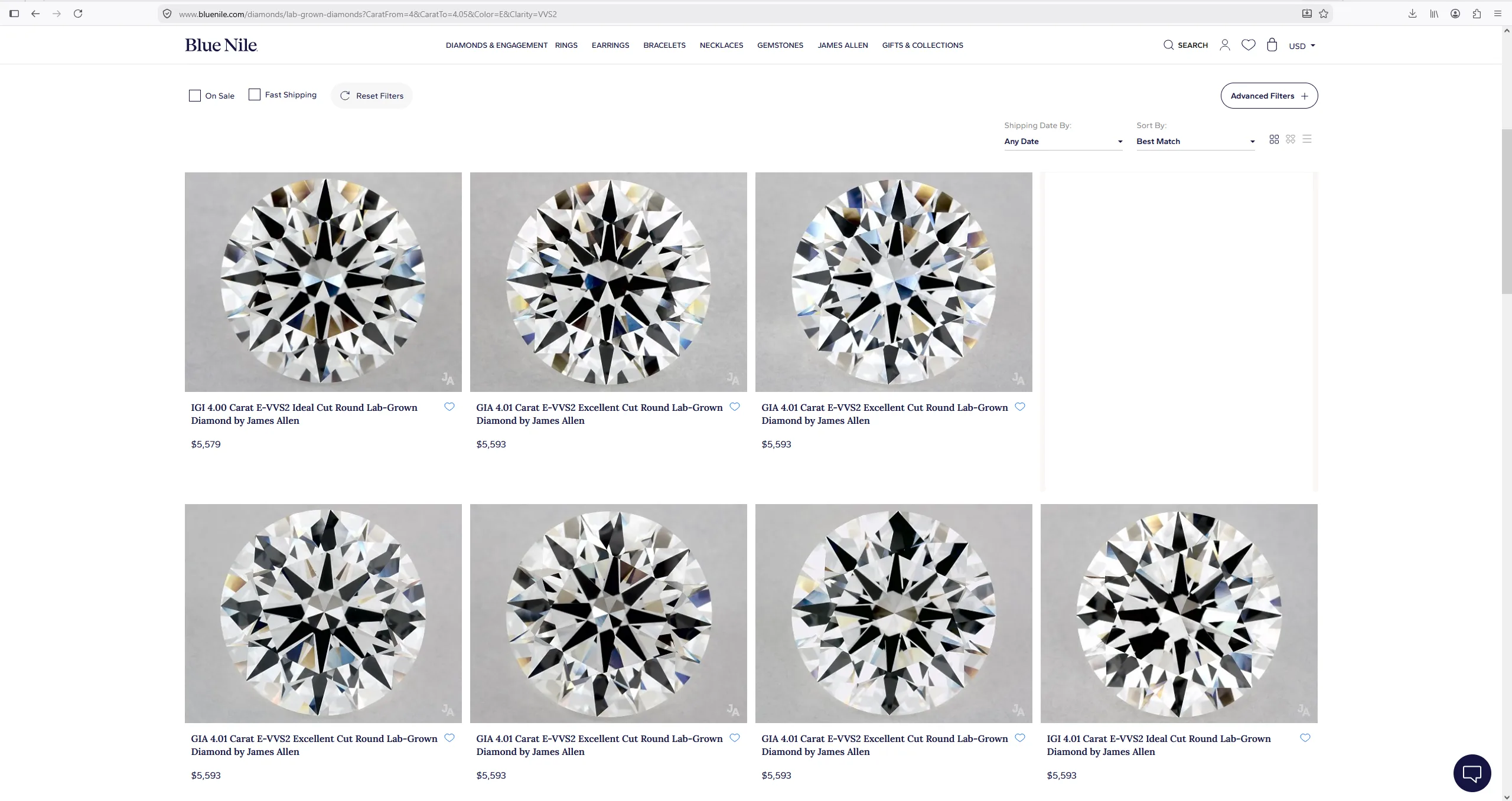
In July 2026 I ran the simplest test there is. On Blue Nile, I filtered for a 4-carat, E color, VVS2 clarity round lab-grown diamond. On our site, I searched for the same thing. Not similar — the same specification, graded by the same laboratories.
Here is Blue Nile's result. Every stone on the page is 4.00–4.05ct, E, VVS2. The least expensive is $5,579; the rest sit at $5,593.
And here is the same 4.00ct E VVS2 Ideal-cut round on Icestore. The least expensive is $1,779; the whole page runs $1,779–$1,986.
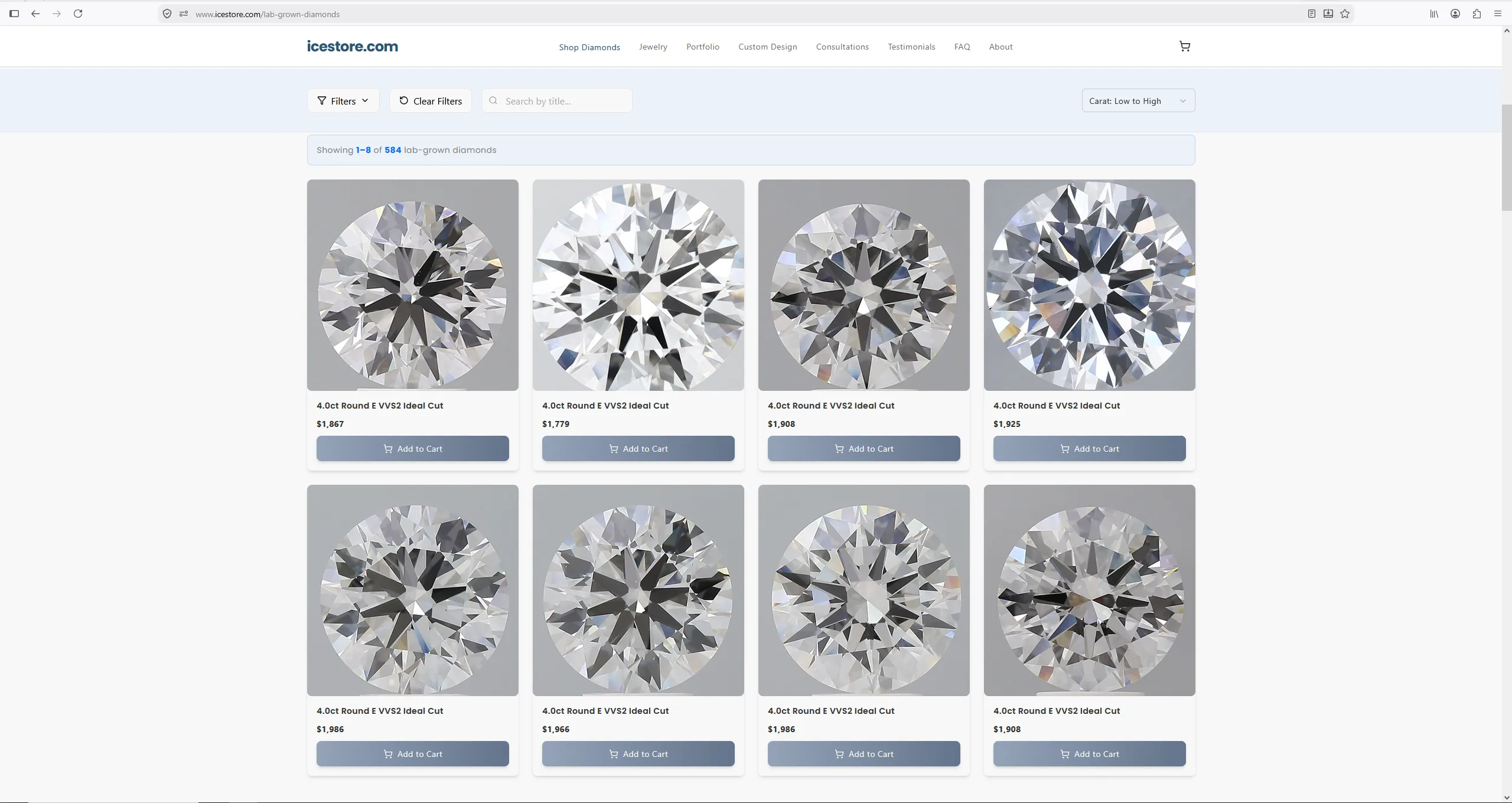
Same carat weight. Same color. Same clarity. Same cut. Compare each site's least expensive 4.00ct E VVS2 stone and the difference is $3,800 — ours is 68% less, which is another way of saying Blue Nile is charging roughly three times the price for the same diamond.
That's not a typo. That's not a promotional discount. That's just Tuesday.
(One point of precision, since this whole article turns on "identical." Blue Nile's cheapest 4.00ct here is graded by IGI; several of the others on their page are GIA. Ours are IGI-graded, Ideal cut — a like-for-like match to their $5,579 stone. When you run this yourself, hold the lab constant too. It doesn't rescue the price gap; nothing does.)
You're probably wondering what the catch is. There must be something different about these two stones, right? Blue Nile wouldn't charge three times more for the same thing.
They would, and here's why — it has nothing to do with the diamond and everything to do with what's stacked on top of it.
Before the why, here's the what. Three matched comparisons, each cheapest-to-cheapest, same lab and cut grade on both sides, captured July 2026:
| Diamond (lab-grown) | Blue Nile | Icestore | You save |
|---|---|---|---|
| 4.00ct Round · E · VVS2 · IGI | $5,579 | $1,779 | $3,800 (68%) |
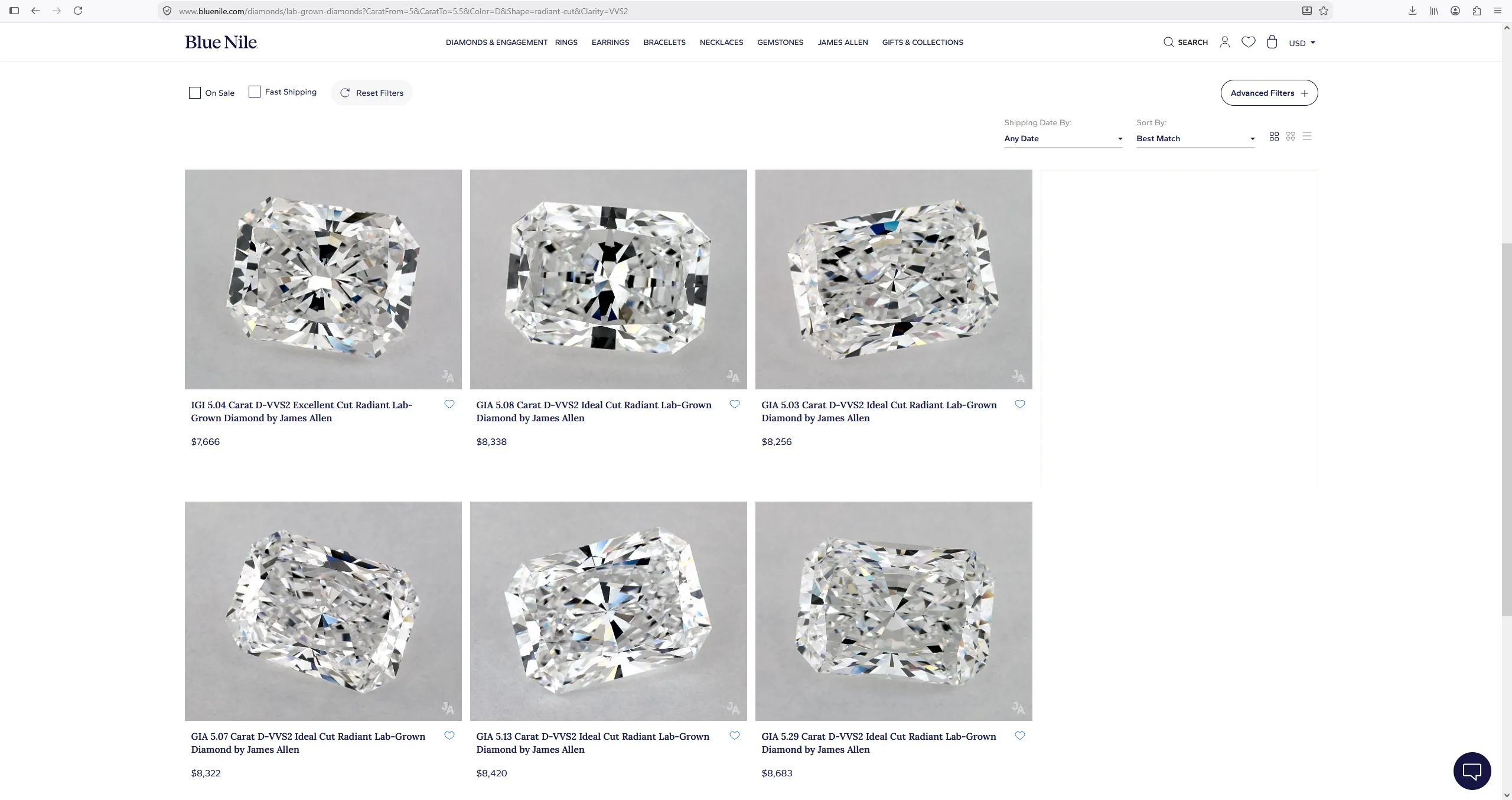
| 5.03ct Radiant · D · VVS2 | $7,666 | $3,778 | $3,888 (51%) |
| 7.02ct Emerald · E · VVS2 · IGI | $9,332 | $3,453 | $5,879 (63%) |
Every row is a screenshot further down the page — specs and prices visible, nothing cropped. Check them.
Let's Talk About Signet for a Minute
Something Blue Nile's website doesn't lead with: Blue Nile is owned by Signet Jewelers. You know Signet. They're the company behind Kay, Zales, and Jared — and since 2017, JamesAllen.com.
So when you're carefully comparison shopping between Blue Nile and James Allen, feeling like a savvy consumer weighing your options? You're comparing Pepsi to Pepsi in a different can. Same parent company, same margin structure, same incentive to keep prices exactly where they are.
The numbers are public. Signet bought James Allen for $328 million in 2017. It bought the Diamonds Direct chain for $490 million in 2021. It bought Blue Nile for $360 million in 2022. That's over a billion dollars spent consolidating the online diamond market into a single portfolio — and acquisitions at that scale have to earn their keep. The way they earn it is margin.
This is Economics 101, dressed up in a pretty website with 360° videos. (Ours are better.)
The Boutique and the Warehouse
Icestore serves a handful of clients a day. That's the entire model. We're not processing hundreds of orders before lunch. We're not answering to a board in Akron. We're not justifying a nine-figure acquisition to shareholders who want their return this quarter.
What we do have: 25 years of direct manufacturer relationships, a live inventory of over 250,000 certified stones, IGI or GIA certification on every diamond, insured shipping, and one person who has personally checked the stone before it ships.
That's not a smaller version of Blue Nile. It's a different structure with different costs — and the difference lands in the price you pay rather than in a marketing budget.
Real Comparisons, Real Numbers
One example could be a fluke. Here's a second, at a different size and a different shape.
Five carats. Radiant cut. D color, VVS2 clarity.
Blue Nile's least expensive is an IGI 5.04ct D-VVS2 Excellent-cut radiant at $7,666; the rest of the page runs $8,256–$8,683.
The same 5.03ct Radiant D VVS2 Excellent-cut on Icestore is $3,778, with the whole page between $3,778 and $3,926.
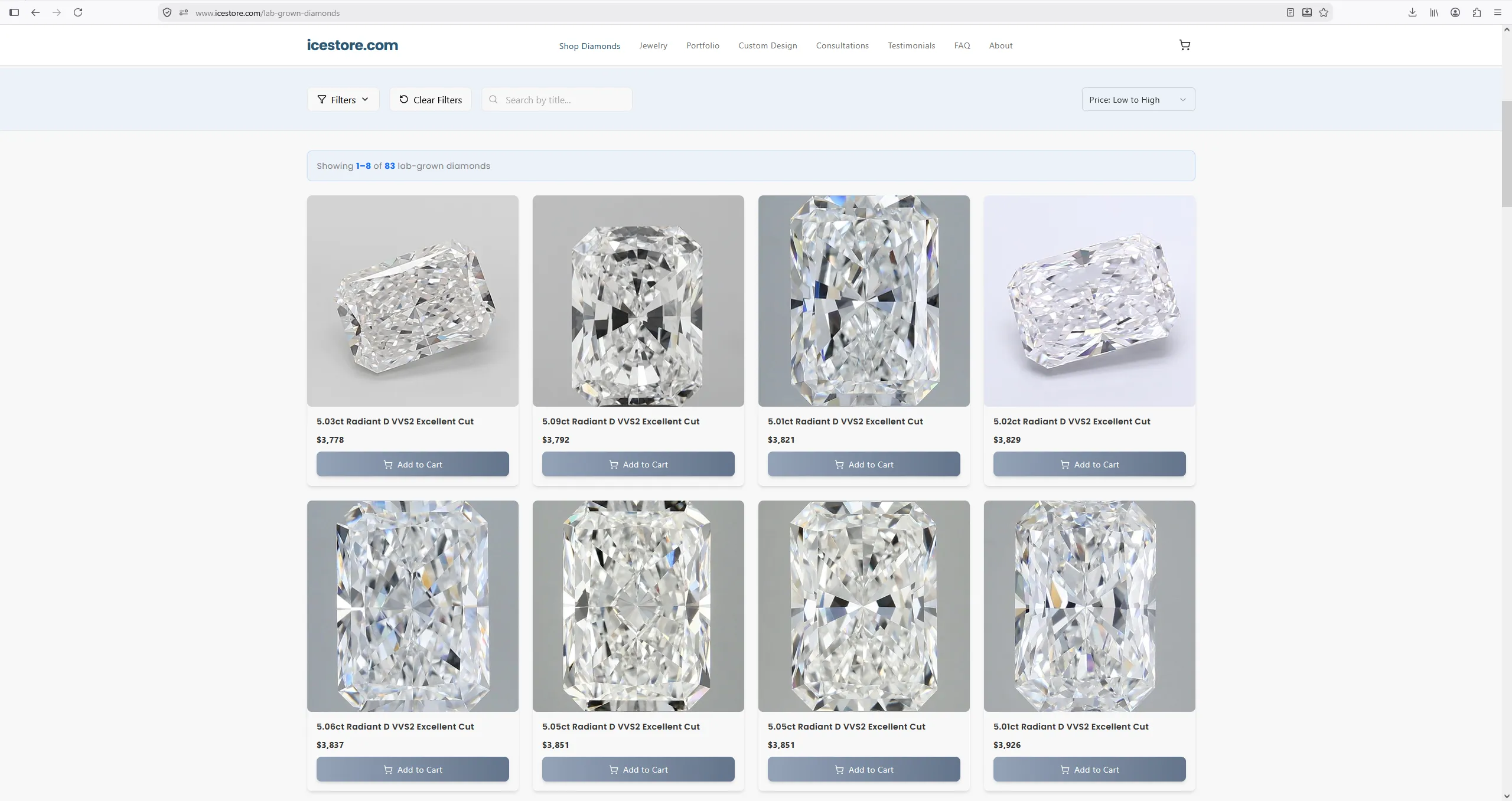
Cheapest to cheapest — matched on lab, shape, colour, clarity, and cut grade — that's $3,888 saved, 51% less. Blue Nile is asking almost exactly double.
And a third — bigger again, and a third shape.
Seven carats. Emerald cut. E color, VVS2 clarity.
Every stone on Blue Nile's page is IGI, Excellent cut. The least expensive is a 7.01ct at $9,332, up to $9,638.
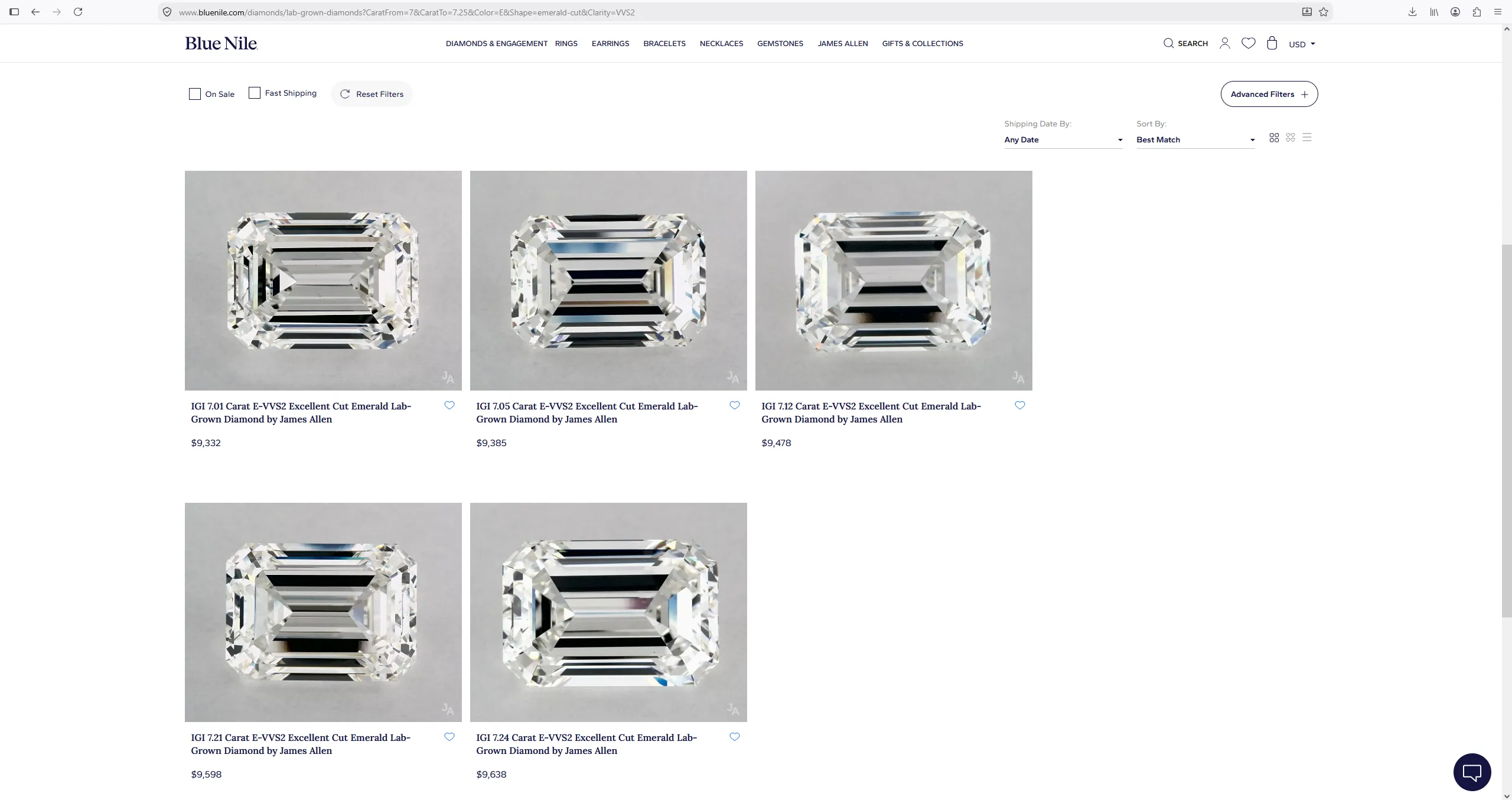
On Icestore, the least expensive Excellent-cut 7.02ct E VVS2 emerald is $3,453.
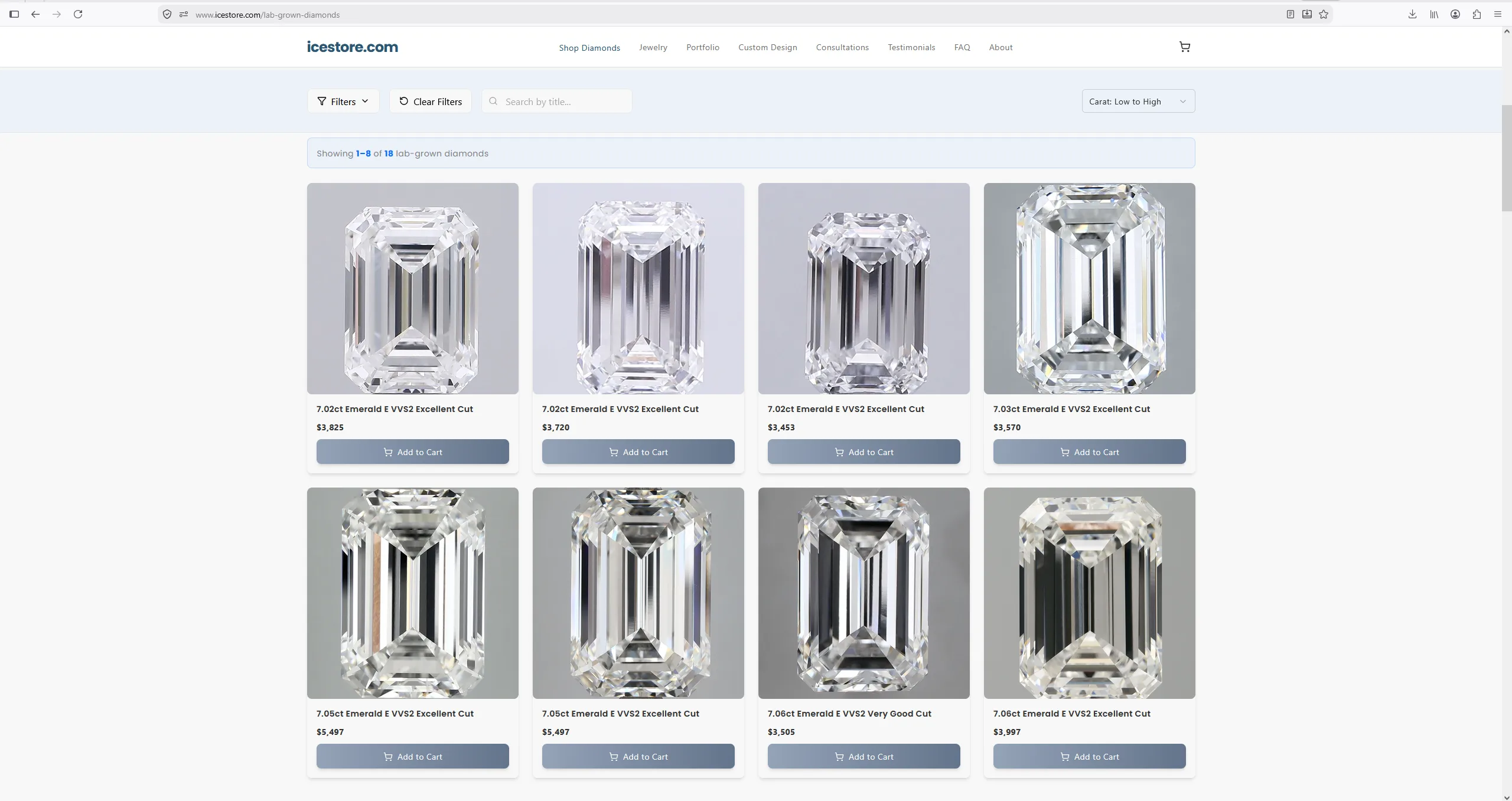
Matched IGI-to-IGI, Excellent-to-Excellent, that's $5,879 saved — 63% less. Nearly six thousand dollars, for the same diamond.
(A note on reading that Icestore page fairly: the second tile is a 7.06ct at $3,505, but it's a Very Good cut, not Excellent. I'm comparing the cheapest Excellent to Blue Nile's cheapest Excellent, because grade has to be held constant for the comparison to mean anything. It happens to also be the cheapest stone on the page — but the grade match is the point.)
Look at what the three comparisons show together. The percentage bounces around — 68% on the 4-carat round, 51% on the 5-carat radiant, 63% on the 7-carat emerald. The dollar figure climbs with size, from $3,800 to nearly $5,900. What doesn't change is the shape of it: every single time, Blue Nile is charging two to three times our price for the same diamond, and every single time you walk away with thousands of dollars still in your pocket. That's the tell. It isn't a clearance event or a loss leader. It's a structural difference in what each business needs to charge — and it shows up across every shape, size, and grade we've checked.
Prices captured on the dates shown. Diamond inventory and pricing change daily on both sites; verify current pricing before you buy. That's rather the point of this article.
"But Blue Nile Has Free Returns and Great Service"
So do we. Next question.
Seriously, though — let's address it properly. Blue Nile has spent a great deal convincing you that their customer experience justifies the premium. The slick site, the aggressive search ads, the retargeting that follows you around the internet like a desperate ex.
Here's what we offer: free returns, free insured shipping, lifetime warranties, and GIA or IGI certification on every stone. Plus an A+ BBB rating and 25 years of not giving anyone a reason to complain.
The difference isn't the service. It's that we're not funding Times Square billboards, influencer partnerships, or a marketing department of forty people optimising landing pages. We're selling the same diamonds at prices that reflect what they actually cost.
How We Actually Source Diamonds
Blue Nile sources through the wholesale networks everyone uses. So do we. The stones come from the same manufacturers, graded by the same labs, against the same criteria.
The difference is what sits between the manufacturer and you. We don't have seven layers of corporate structure, regional managers, or a Park Avenue office to fund. We have direct relationships built over 25 years and a deliberate decision not to build any of that.
"Can I Really Trust a Small Business With This?"
This is the honest objection, and it deserves an honest answer rather than a joke.
You're about to spend a significant amount of money with a company you've just found. Being cautious about that is correct. If you weren't, I'd worry about you. So here's what actually protects you — check every one of these, and hold us to them:
- Independent certification. Every diamond is graded by IGI or GIA, not by us. The report number is on the listing. Look it up on the lab's own site before you buy — for any vendor, including us.
- The stone you see is the stone you get. The 360° video and image on each listing is that specific diamond, not a stock rendering.
- 30-day returns, free, no argument. If it isn't right, it comes back.
- Verifiable trading history. 25 years, an A+ BBB rating, and a public review record. Go read it.
- Lifetime warranty on craftsmanship and materials.
If, having checked all of that, you'd still rather buy from a large corporation — that's a legitimate choice and I'm not going to mock you for it. Some people prefer the reassurance of scale, and it's your money.
I'd just ask you to name what you're getting for the difference. If you can point to something concrete, buy it. If the answer is a feeling of corporate legitimacy, that feeling is expensive.
What They Won't Tell You About "Their" Diamonds
You'll hear things like "it's the cut of our diamonds." Really? Are your diamonds cut to better-than-Ideal proportions? Have you discovered how to warp spacetime for extra brilliance using eleventh-dimensional quantum effects?
No? In Blue Nile's case, they invented a grade and called it "Astor." Perhaps that's short for Astor-onomically overpriced. Astor-nishingly expensive. Okay, I'll stop.
Here's the thing worth understanding: cut grades above Excellent/Ideal are marketing constructs, not laboratory standards. GIA's scale tops out at Excellent. IGI's tops out at Ideal. Anything above that is a brand name, not a gemological grade — and you're paying for the name.
The Part Where I Get Real
I started Icestore in 2001 because I was appalled by jewellery store pricing. Not mildly annoyed — appalled. I watched people spend $20,000 on diamonds that cost the jeweller $4,000, and thought: this is insane.
Twenty-five years later, the industry has only consolidated further. Fewer independent competitors, more private-equity ownership, and marketing budgets that exist to maintain the impression that the markup is somehow justified.
Blue Nile used to be the disruptor. They were the ones challenging traditional retail margins and offering better prices online. Then they succeeded, got acquired — twice — and became the thing they originally disrupted.
We're doing what Blue Nile used to do, before quarterly earnings became the priority.
What You Should Actually Do
Don't take my word for any of this. Please don't.
Go to Blue Nile right now. Find a diamond you like. Write down the exact specification: carat weight, colour, clarity, cut grade, shape, and certifying lab.
Then come to our lab-grown inventory and find the same thing. Not similar — identical. Same lab, same grades across the board.
Compare the prices. Then ask what the difference is buying you.
The Bottom Line
Same certifications. Same return policy. Same warranties. Same stones, from the same manufacturers, graded by the same laboratories.
Is this an advertisement? Obviously. I'm not pretending to be Consumer Reports.
But it's an advertisement built entirely on things you can verify yourself in about three minutes — which is more than most of the industry can say.
Ready to compare?
Browse our lab-grown diamond inventory or schedule a consultation to talk through what you're looking for. No pressure, no sales tactics — just honest information about what things actually cost.
Ari Gold Founder, Icestore Still annoyed by jewellery industry pricing since 2001
Enjoyed the honesty? We also wrote The Top 10 Reasons NOT to Buy a Lab-Grown Diamond — every reason is a joke, and every joke is true.